AerCap Holdings ($AER): Getting Paid for the Aircraft Shortage
Aircraft shortages have strengthened AerCap’s lease economics and asset values. The question is whether those returns can endure once supply normalizes.

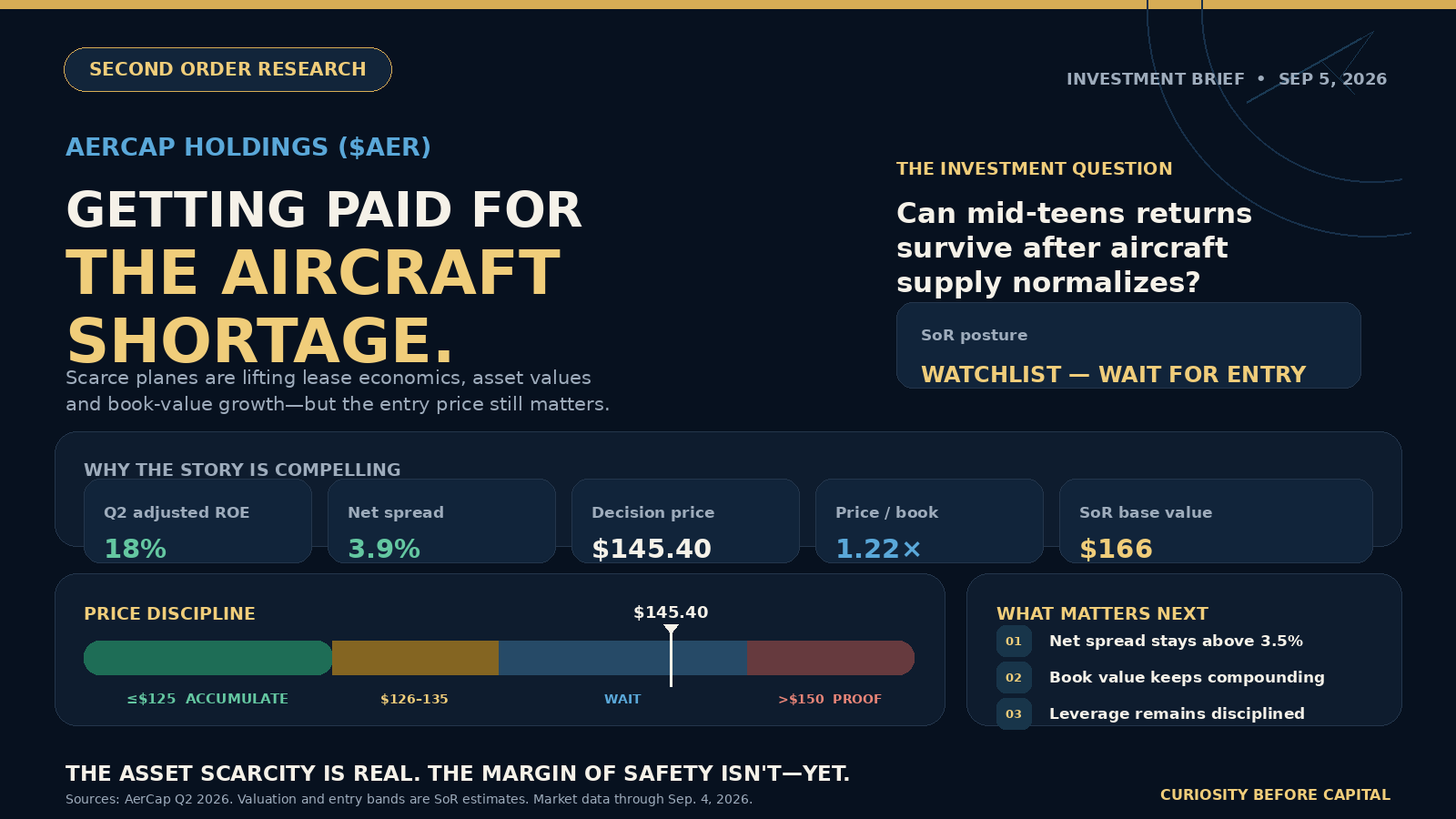
Boeing and Airbus production problems have made existing aircraft more valuable. AerCap owns the scarce assets, the delivery slots and the financing platform—but the stock now prices in a meaningful part of that advantage.
The company is stronger than the “leveraged airline proxy” label—but the stock is no longer deep value.
What may be mispriced: AerCap is not merely financing aircraft. Its scale, delivery slots, customer network and lifecycle capabilities let it monetize scarcity through higher lease economics, extensions, asset sales and opportunistic repurchases. Boeing and Airbus execution failures have become AerCap pricing power.
Why not buy aggressively here: at $145.40 the shares trade at 1.22× June book value. Management's $16.80 2026 adjusted EPS guide includes first-half gains on sale; stripping those out produces roughly $14 of core EPS by our calculation. The headline 8.7× multiple therefore understates how much favorable scarcity and asset pricing are already in the number.
Action: keep AerCap on the research watchlist. A starter becomes attractive around $130–135 if operating evidence remains intact; below roughly $125, the setup offers a more convincing margin of safety. At today's price, require continued mid-teens returns and double-digit book-value growth.
Can AerCap compound after scarcity normalizes?
The thesis works if AerCap sustains at least low-to-mid-teens adjusted ROE and high-single-digit book-value-per-share growth after aircraft deliveries recover and sale gains normalize.
It weakens if net spread after depreciation falls below roughly 3%, adjusted leverage rises above 2.7× without clearly accretive deployment, or book value per share stops growing for two consecutive quarters.
PM judgment; thresholds are underwriting tests, not management guidance.
The central debate: cyclical lessor or capital-allocation compounder?
OEM delays, engine constraints and traffic growth keep lease rates and aircraft values elevated. AerCap converts that environment into mid-to-high-teens ROE and continued BVPS compounding.
Lease economics remain strong through 2028, then normalize gradually. AerCap still compounds, but the current premium to book leaves only mid-teens base-case total-return potential.
Aircraft supply improves as airline demand softens. Sale gains compress, lease resets weaken and funding costs remain elevated, pulling ROE toward the cost of equity and the stock back below book.
Variant perception
Known fact: the commercial-aircraft backlog exceeds 18,000 and airlines are short more than 5,000 replacement aircraft they expected to have; IATA says lease rates have risen roughly 20–30% since 2019.
Potentially mispriced insight: AerCap's advantage is not simply owning aircraft during a shortage. It can move capital among new orders, sale-and-leasebacks, extensions, engines, helicopters, asset sales, debt reduction and its own shares. That option set may deserve a durable premium to book—but only if returns remain elevated when today's shortage fades.
Industry facts: IATA, 24 Jun. 2026 and IATA/Oliver Wyman supply-chain study, 9 Dec. 2025. Variant perception is SoR judgment.
What $145.40 appears to price in
2026 adjusted EPS guidance of $16.80. This is the flattering headline multiple because the guide includes first-half gains on asset sales.
SoR normalized 2026 EPS of about $14 after deducting the estimated after-tax contribution from first-half sale gains.
Price to reported June 2026 book value of $119.21 per share. The market already awards AerCap a meaningful premium to accounting equity.
The current price is consistent with a market expecting aircraft scarcity to remain favorable, adjusted ROE to stay in the mid-teens and capital allocation to keep lifting per-share value. It does not require today's 18–19% adjusted ROE forever—but it leaves limited protection if returns fall quickly toward 10–11%.
Sources: AerCap Q2 2026 results; closing price from current market data at 4 Sep. 2026. Normalized EPS is model-derived.
The business is a global aircraft owner, trader and problem solver
| Platform component | Current scale | Why it matters |
|---|---|---|
| Aircraft | Approximately 1,589 owned and managed aircraft; 7.4-year average age for owned passenger aircraft. | Largest pool of globally mobile aviation assets. A 7.2-year average remaining contracted lease term adds cash-flow visibility. |
| Engines | Approximately 1,300 engines, excluding 29 engines on order at the SES joint venture. | Engine shop-visit and spare-parts constraints create a separate scarcity pool from whole aircraft. |
| Helicopters | More than 300 helicopters. | Diversifies the platform beyond commercial airlines and expands remarketing and technical capabilities. |
| Order book | About 400 aircraft, engines and helicopters; more than 90% of aircraft orders are new-technology narrowbodies. | Delivery slots themselves are scarce strategic assets. The tradeoff is large future purchase commitments and financing needs. |
| Customers | Approximately 300 customers globally. | No single airline dominated 2025 lease revenue; the five largest customers represented 18.5% in aggregate. |
Sources: AerCap corporate fact sheet, 30 Jun. 2026; Q2 results; 2025 Form 20-F.
Financial and capital-structure check: strong returns, real leverage
Q2 / H1 operating scorecard
| Metric | Q2 2026 | H1 2026 |
|---|---|---|
| Total lease revenue | $1.85B | $3.73B |
| Adjusted EPS | $5.14 | $10.53 |
| Adjusted ROE | 18% | 19% |
| Net spread after D&A | 3.9% | 3.9% |
| Operating cash flow | $1.5B | $2.89B |
| Asset-sale gains | $223M | $514M |
Capital structure at 30 June
| Item | Value | Read-through |
|---|---|---|
| Debt | $42.77B | Core operating funding, not incidental leverage. |
| Unrestricted cash | $1.69B | Reduces adjusted debt. |
| Adjusted debt | $39.96B | Includes 50% equity credit for subordinated debt. |
| Adjusted equity | $19.54B | Basis for the 2.05× adjusted leverage ratio. |
| Sources-to-uses | 1.9× | About $22B of sources over the next 12 months. |
| Average cost of debt | 4.2% | Up 10 bps year over year in Q2. |
Financed-growth gate: AerCap currently clears the liquidity and near-term refinancing tests: it is rated BBB+ / Baa1 / BBB+ with stable outlooks, secured debt is about 9% of assets and adjusted leverage is below management's 2.7× target. It does not yet clear the full-cycle return test at today's valuation because current sale margins and lease scarcity are above normal.
Approximate capitalization: applying the $145.40 price to the Q2 diluted weighted-average share count gives roughly $23.0 billion of equity value. Adding debt and subtracting unrestricted cash produces an approximate $64.1 billion enterprise value. For a lessor, EV is not the primary valuation anchor because debt directly funds earning assets; price-to-book, ROE and per-share book compounding are more decision-useful.
Sources: Q2 2026 results and reconciliation; AerCap fixed-income overview. Capitalization is model-derived from 157.96M diluted weighted-average shares; the basic outstanding count excluding unvested restricted stock was 154.43M.
The competitive wedge is scale plus optionality—not a proprietary airplane
BBB+ credit across the three major agencies and mostly unsecured funding widen the set of transactions AerCap can pursue when weaker buyers retreat.
Approximately 300 customer relationships and a diversified fleet reduce downtime and increase the probability of finding the highest-value next owner or lessee.
AerCap buys, leases, maintains, repossesses, converts, sells and parts out assets. Repeated transactions improve pricing and residual-value judgment.
The strongest alternative is BOC Aviation, a listed Hong Kong lessor with a younger fleet and 11.9% FY2025 ROE. But AerCap's 3,567 total owned, managed and on-order aviation assets and multi-product platform are materially broader than BOC's 811 aircraft and engines. Avolon is the closest scale competitor at 1,117 total aircraft, but it is private. Air Lease was acquired in April 2026, further reducing U.S.-listed pure-play choice.
The moat caveat: scale cannot prevent airline defaults, engine defects, sanctions or residual-value mistakes. It mainly gives AerCap more ways to respond—and lower financing friction—when those events occur.
Sources: BOC Aviation H1 2026 results; Avolon Q2 2026 update; Air Lease transaction close.
Valuation: book value and normalized earnings tell the same story
The primary method is 18-month price-to-book because AerCap is an asset-heavy financial business whose debt funds the fleet. We cross-check with normalized adjusted EPS. Both methods deliberately assume the current 20% unlevered sale margin fades; neither gives full credit for a permanent shortage.
| Scenario | Weight | 2027E BVPS | Exit P/B | P/B value | 2027E norm. EPS | P/E | P/E value |
|---|---|---|---|---|---|---|---|
| Bear Fast normalization + softer demand | 25% | $124 | 0.90× | $112 | $12.50 | 9× | $113 |
| Base Gradual normalization | 50% | $138 | 1.20× | $166 | $15.00 | 11× | $165 |
| Bull Scarcity persists into 2030s | 25% | $146 | 1.35× | $197 | $18.00 | 11× | $198 |
Approximately 23% price downside before dividends. Sale gains compress, impairments rise and the stock revisits a discount to book.
Approximately 14% price upside, or about 16% including six assumed $0.40 quarterly dividends over 18 months.
Approximately 36% price upside, or about 37% with dividends. Requires continued high-teens returns and favorable asset values.
Probability-weighted value: approximately $160 before dividends, or about 12% expected total return over 18 months using the stated weights and a flat $0.40 quarterly dividend. That is positive, but not enough to compensate for the leverage, cyclicality and estimation uncertainty required for a full position.
All 2027 estimates, scenario weights, multiples and values are SoR model outputs. Starting BVPS of $119.21 and the current dividend are from AerCap Q2 2026 results. Values are rounded; future dividends are assumed, not guaranteed.
Entry discipline: insist on either price or proof
About 1.05× current book. Better protection against a return-to-normal sale market and closer to the bear/base midpoint.
Begin small only if net spread stays above 3.5%, leverage remains below 2.3× and Q3 lease/sale activity confirms demand.
Do not chase the scarcity narrative. Require higher BVPS estimates or evidence that mid-to-high-teens ROE is durable beyond 2027.
Capital-allocation nuance: repurchases below book are clearly accretive to BVPS. Q2 repurchases occurred around $141 per share on average—above June BVPS—so they are more obviously accretive to EPS than to book value. The still-favorable arbitrage is that Q2 asset sales generated 1.7× book value on an equity basis while the stock traded closer to 1.2× book, but that advantage narrows as the share price rises or sale margins fall.
Repurchase and sale figures: AerCap Q2 2026. Entry bands are PM judgment.
Catalyst path
| Window | Event | What must be learned | Decision impact |
|---|---|---|---|
| 9 Sep. 2026 | Deutsche Bank Aviation Forum | Management's view on extension rates, OEM delivery timing, sale margins and capital allocation above book. | Soft catalyst; improves or weakens confidence, not value by itself. |
| Early Oct. 2026 inferred from cadence | Q3 transaction update | Lease agreements, purchases, sales and financing activity. | First operational test since Q2. |
| Late Oct. 2026 estimated; not announced | Q3 results | Net spread after D&A, asset-sale gain, BVPS, leverage, EPS guide and repurchase pace. | Primary near-term re-underwrite. |
| 2027–2028 | OEM production and engine-shop recovery | Whether deliveries actually narrow the shortage faster than traffic grows. | Determines whether current returns are cyclical peak or durable plateau. |
| 2030–2033 | New 787 delivery stream | Placement economics and widebody scarcity. | Long-duration growth option, not a near-term catalyst. |
Confirmed conference date: AerCap IR calendar. Transaction and earnings windows are inferred from prior-year cadence and must not be treated as confirmed dates.
Principal risks and falsifiers
Falsifier: lease-extension rates and sale margins fall sharply while OEM deliveries accelerate, pushing net spread after D&A below 3%.
Falsifier: receivables, credit-loss provisions, restructurings or repossessions rise across multiple regions—not one isolated airline.
Falsifier: average debt cost rises faster than lease yields for four quarters, compressing net spread despite high utilization.
Falsifier: repeated impairments or sale proceeds near/below carrying value replace today's 20%-plus gains.
Falsifier: leverage moves above 2.7× for buybacks above book or acquisitions/order commitments without a clearly superior return.
Falsifier: sanctions, conflict or jurisdictional restrictions strand assets faster than insurance and diversification can absorb.
Downside mechanism: because aircraft are debt-funded, a modest decline in asset values or lease spreads can produce a larger move in equity value. The bear case is not simply “air travel slows”; it is simultaneous pressure on lease income, sale gains, credit costs and book-value confidence.
Investor monitoring sheet
- Net spread after depreciation: Q2 was 3.9%. Stay constructive above 3.5%; re-underwrite below 3.0% unless a temporary accounting item explains the move.
- Book value per share: June BVPS was $119.21, up 16% year over year. Require at least high-single-digit growth through 2027 for the current premium to book.
- Adjusted ROE: Q2 was 18%. The valuation needs low-to-mid-teens normalized returns; two quarters below 12% would weaken the compounder thesis.
- Sale margin and volume: separate recurring lifecycle gains from shortage-driven windfalls. Watch both the percentage margin and dollars realized.
- Leverage and liquidity: adjusted debt/equity was 2.05× and next-12-month sources-to-uses coverage 1.9×. Do not let repurchases consume the balance-sheet advantage.
- OEM delivery versus traffic growth: aircraft supply matters only relative to airline demand. Track both, not Boeing/Airbus headlines in isolation.
Evidence notes and open work
Evidence confidence: high for reported financials, fleet scale, leverage, liquidity, customer concentration and industry backlog; these come primarily from AerCap filings/releases and IATA. Medium for positioning and trading context, which rely on public market-data pages.
Underwriting status: preliminary watchlist initiation. The brief supports a decision posture and entry bands, but not a full ownership recommendation. A complete through-cycle model still needs aircraft delivery schedules, lease-rate reset cohorts, maintenance cash flows, debt repricing by year and a normalized gain-on-sale history.
Source conflict: one automated market-data feed reported market capitalization near $28.8 billion, inconsistent with both the Q2 share count and other market-data pages. This brief excludes that figure and calculates approximate equity value from the latest filed diluted share count. No current consensus estimate feed was available; scenario estimates are explicitly SoR assumptions.
Ownership and liquidity: public market data indicates approximately 1.1 million shares of average daily volume and short interest around 1.8% of float in mid-August 2026. These suggest a liquid, uncrowded long rather than a squeeze setup, but they are not central to the thesis.
Source register
| ID | Source | Date / period | Use | Confidence |
|---|---|---|---|---|
| S1 | AerCap Q2 2026 earnings release | 29 Jul. 2026 / Q2 & H1 | Earnings, guidance, book value, shares, debt, sale gains, fleet, dividend | High · primary |
| S2 | AerCap 2025 Form 20-F | 12 Feb. 2026 / FY2025 | Customers, geography, commitments, accounting, interest-rate and asset risks | High · filing |
| S3 | AerCap fixed-income overview | 30 Jun. 2026 | Ratings, maturities, funding mix, liquidity and leverage history | High · company data |
| S4 | IATA supply-chain priorities | 24 Jun. 2026 | Backlog, fleet age, replacement-aircraft shortfall | High · industry body |
| S5 | IATA/Oliver Wyman study | 9 Dec. 2025 | Lease-rate inflation and expected normalization window | High · industry study |
| S6 | BOC Aviation H1 2026 | 20 Aug. 2026 / H1 | Public-peer fleet, age, lease term and ROE | High · competitor |
| S7 | Avolon Q2 update | 3 Jul. 2026 / Q2 | Private-peer fleet and customer scale | High · competitor |
| S8 | AerCap IR calendar | Accessed 5 Sep. 2026 | Confirmed conference dates; earnings date remains unannounced | High · primary |
| S9 | MarketWatch AER market data | 4 Sep. 2026 close | Cross-check price, shares, float, volume and short interest | Medium · market data |