Adeia Inc. (ADEA): The Hidden Tollbooth Beneath AI Chips
Hybrid bonding may become critical infrastructure for advanced AI hardware. The bigger opportunity could be the contracts that were priced before it mattered.

FLAGSHIP DEEP DIVE · SEMICONDUCTORS
Executive summary: ~3 minutes · Full Deep Dive: long-form research
Executive Research Snapshot
Strong structural thesis. Timing and contractual repricing remain unproven at the current valuation.
SoR Posture
Thesis: Intact
Structural conviction: High
Timing conviction: Moderate
Core IP / royalty moat: Strong
Renewal durability: Strong
Repricing opportunity: Attractive but still unproven
Operating leverage: Attractive
Financial execution: On track
Balance-sheet risk: Low
Valuation: Attractive long term, but not enough margin of safety to chase
The core Adeia thesis has not changed: this is a high-margin intellectual-property business whose upside depends less on explosive end-market growth than on the durability, renewal and eventual repricing of its licensing relationships.
The largest remaining valuation hinge is repricing. Renewals can validate the durability of the moat, but materially better economics are what would justify a larger step-up in intrinsic value.
For now, SoR remains WATCH — DO NOT CHASE. The company thesis is stronger than the immediate stock setup. We would rather wait for a better margin of safety than raise fair value simply because the underlying business continues to execute.
Executive Summary
The thesis in one sentence
Adeia may own economically important intellectual property underneath hybrid bonding just as that technology becomes more important to advanced AI hardware—and several major licensing relationships may approach renewal after that importance has increased.
That creates a potentially unusual setup

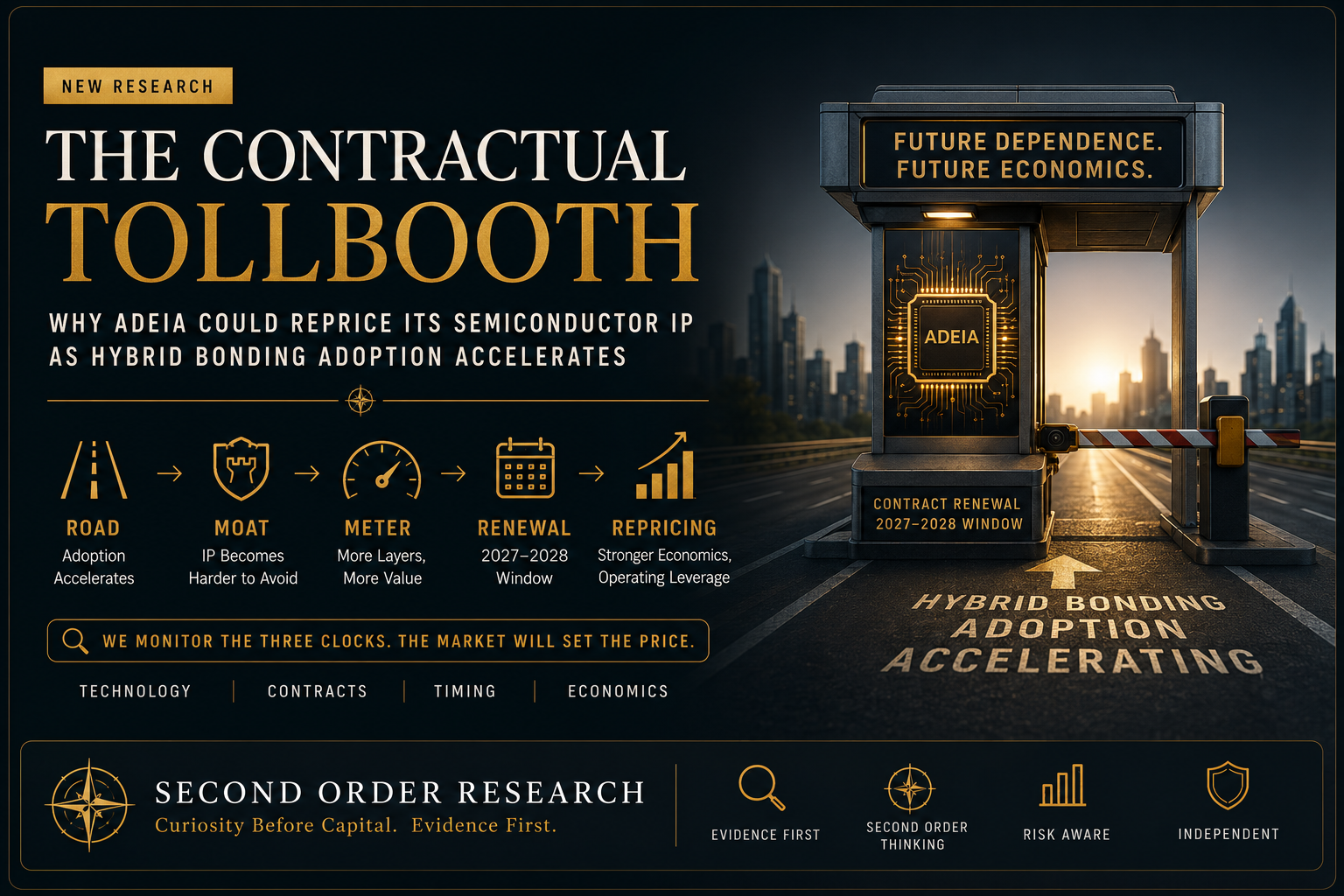
Road → Moat → Meter → Renewal → Repricing → Operating Leverage
The obvious AI opportunity is usually the company selling the scarce product.
Adeia may represent something different:
the owner of an economic right underneath the product.
What we found
Hybrid bonding is increasingly relevant to the semiconductor industry's attempt to connect logic, memory, and chiplets at much finer pitches while improving bandwidth, power efficiency, density, and thermal performance.
The technology is already commercially established in applications such as image sensors and NAND. Its next potentially important expansion is into advanced logic and increasingly dense memory architectures.
Adeia does not own hybrid bonding as a category.
But the evidence suggests it owns a meaningful collection of patents and process know-how around the technology.
Its semiconductor relationships include major memory manufacturers and other sophisticated counterparties. Several agreements explicitly cover hybrid bonding, and some include technology transfer rather than merely patent access.
AMD provides particularly useful evidence.
After Adeia filed patent litigation involving hybrid-bonding and advanced-node IP, AMD entered into a multi-year license covering Adeia's broader semiconductor portfolio.
That does not prove Adeia's patents would have won in court.
It does show that a sophisticated semiconductor company with substantial technical and legal resources ultimately chose a commercial license.
We view that as meaningful validation of the portfolio's negotiating value.
Where the second-order opportunity appears
Technology adoption alone is not enough.
The contract determines who captures the economics.
Adeia uses a mixture of:
fixed-fee licenses
variable royalties
minimum guarantees
and other licensing structures.
Under a fixed contract, semiconductor volumes can rise dramatically without Adeia receiving proportionately more revenue.
That creates the interesting part of the thesis.
If contracts were negotiated when hybrid bonding mattered less, but customers become more dependent on the technology before the next negotiation, Adeia may eventually have an opportunity to reset the meter.
Public earnings-call discussion points toward an important larger-customer renewal window around 2027–2028, including relationships involving major memory manufacturers.
We do not possess the individual contracts or their confidential economics.
So we treat this as a renewal window, not a known customer-by-customer expiration schedule.
The timing problem
This is also the largest reason we are not chasing the stock.
Current HBM4 and 12-layer HBM4E demonstrate that conventional packaging remains viable.
Hybrid bonding appears increasingly attractive farther up the roadmap—particularly around higher-layer-count memory and more demanding 3D architectures—but widespread adoption has not yet occurred.
That creates three clocks:
Technology — when does hybrid bonding become sufficiently important?
Contract — when can Adeia renegotiate?
Negotiation — when do customers believe future dependence is strong enough to affect today's contract terms?
Those clocks do not have to strike on the same day.
A manufacturer can negotiate today for technology it expects to need several years from now.
But if meaningful dependence develops after the relevant renewal cycle, the most attractive version of the repricing thesis becomes weaker.
That is why our:
Structural Conviction is High
while
Timing Conviction remains Moderate.
What the market already knows
ADEA is not an undiscovered AI stock.
At approximately $26 per share, the company has already been substantially rerated from its lows, and investors increasingly recognize the semiconductor and hybrid-bonding opportunity.
So our thesis is not:
The market has never heard of hybrid bonding.
A more useful expectations gap is:
The market may recognize the technology opportunity without correctly estimating how much economic value Adeia can capture when existing contracts eventually reset.
That remains unresolved.
Valuation
Our 2029 scenario work produces approximately:
Bear: ~$15
Hybrid bonding arrives slowly, licensing economics disappoint, semiconductor growth remains lumpy, and legacy media weakens.
Base: ~$30
Hybrid bonding adoption progresses, Adeia captures some improved economics, semiconductor licensing grows, and the core media business remains reasonably resilient.
Bull: ~$49
Technology adoption and contract renewals align, memory economics improve materially, AMD becomes precedent for additional logic licensing, semiconductor revenue approaches or exceeds management's longer-term ambition, and operating leverage emerges.
With our current probabilities, the rough probability-weighted value is approximately:
$31 per share
At $25.23, that is positive expected value.
It is not enough expected value for us to ignore the remaining uncertainty.
Our current decision
WATCH — DO NOT CHASE
Under the evidence available today:
$23–24 → Starter territory
$21–22 → Attractive
$19–20 → Preferred accumulation
Below $18 → Potentially compelling, but only after determining why the stock reached that level
Those are not standing buy orders.
A lower price only improves the opportunity if the thesis remains intact.
Likewise, ADEA could become attractive without falling if independent evidence improves enough to raise our Base and Bull probabilities.
What would change our mind?
The thesis strengthens if we see:
- commercial hybrid bonding moving into higher-layer-count HBM and advanced logic;
- another major logic semiconductor license following AMD;
- memory-license renewals with broader or visibly stronger economics;
- increasingly recurring or production-linked semiconductor revenue;
- additional technology-transfer relationships; and
- continued operating leverage and debt reduction.
The thesis weakens materially if:
- hybrid bonding expands but Adeia's economics fail to follow;
- major customers demonstrate viable design-arounds;
- important patent claims are invalidated;
- memory renewals show little economic improvement despite greater technological dependence;
- or semiconductor growth remains primarily episodic contract recognition.
The most dangerous outcome would be:
The Road succeeds while the Tollbooth fails.
The deeper question
Adeia ultimately revealed a research pattern larger than the company itself:
Contractual Tollbooth & Royalty Repricing Signal™
Find an asset whose economic terms were negotiated before the world understood how important that asset would become.
Then ask:
Is traffic growing?
Is access difficult to bypass?
How is usage monetized?
When does the contract reset?
Has bargaining power changed?
Will better economics flow through to cash?
That is the deeper reason we find ADEA interesting.
The investment case is still developing.
The analytical mechanism is already useful.
Continue into the full Deep Dive
The research below examines the technology, patent moat, customer relationships, licensing economics, renewal timing, AMD case study, expectations, valuation, preferred entry zones, and explicit falsifiers behind the conclusion above.
The Executive Summary gives you our answer. The Deep Dive shows you why.
1. The Overlooked AI Bottleneck
Most of the AI semiconductor debate focuses on the obvious beneficiaries:
GPUs. HBM. Foundry capacity. Advanced packaging. Power.
But as chips become larger, denser, and increasingly assembled from multiple pieces of silicon, another constraint becomes more important:
how those pieces are physically connected.
Traditional packaging relies heavily on microscopic solder-based connections between dies. Those approaches remain effective, but increasingly demanding systems require more bandwidth, lower power consumption, tighter spacing, and thinner stacks.
Hybrid bonding attacks that problem by connecting semiconductor surfaces much more directly and at much finer pitches.
The technology is already commercially used in areas such as image sensors and 3D NAND. Its next potentially important expansion is into advanced logic, chiplets, high-bandwidth memory, and other architectures being pushed forward by AI and high-performance computing.
That is where Adeia becomes interesting.
Adeia does not manufacture chips.
It owns intellectual property and process know-how associated with hybrid bonding, advanced packaging, and semiconductor integration—and licenses that technology to semiconductor manufacturers.
The investment question is therefore not simply:
Will hybrid bonding grow?
It is:
If hybrid bonding becomes more economically important, how much of that value can Adeia actually capture?
That distinction is the foundation of this report.
Technology adoption does not automatically create shareholder value. The answer depends on the strength of Adeia's intellectual property, the structure of its licensing agreements, the timing of contract renewals, and the bargaining power of its customers.
The first-order thesis is:
AI growth → advanced packaging → hybrid bonding → Adeia benefits.
The second-order thesis is more demanding:
Industry dependence increases → Adeia's IP becomes harder to avoid → existing contract economics become stale → renewal creates an opportunity to reprice access.
That is the mechanism we are underwriting.
Before evaluating the tollbooth, however, we first need to establish that the road itself is real.
2. Road: Why Hybrid Bonding Matters
The semiconductor industry is increasingly improving computing performance not only by shrinking transistors, but by bringing separate pieces of silicon closer together.
AI systems make this especially important.
Modern accelerators must move enormous amounts of data between logic and memory. As compute density rises, the distance, density, power consumption, and thermal characteristics of those connections become increasingly important.
Traditional packaging connects stacked dies using structures such as microbumps and solder-based interconnects.
Those technologies are not disappearing.
But as pitches become finer and stacks become denser, the interconnect itself begins consuming valuable area, adding electrical resistance and stack height, and complicating power and thermal management.
Hybrid bonding changes that geometry.
Instead of relying on comparatively larger solder structures, hybrid bonding can directly join copper interconnects and surrounding dielectric surfaces between semiconductor layers.
That can enable:
Higher bandwidth — more connections across the same area.
Lower power — shorter electrical paths for moving data.
Greater density — tighter integration and thinner stacks.
Better signal characteristics — shorter interconnect distances.
Heterogeneous integration — logic, memory, I/O, accelerators, and other specialized dies can increasingly be assembled into one system.
This last point matters as leading-edge transistor scaling becomes more expensive.
Rather than manufacturing every function on the most advanced process node, chip designers can combine specialized dies built on different processes and connect them through advanced packaging.
The package increasingly becomes part of the computing architecture itself.
The direction is independently visible
This is not simply Adeia's forecast.
TSMC's SoIC platform is built around fine-pitch 3D die integration and emphasizes shorter connections, higher bandwidth, lower power consumption, and improved form factor.
Applied Materials describes hybrid bonding similarly: direct copper-to-copper connections increase I/O density and shorten wiring between chiplets.
The direction is also becoming visible in memory.
None of this means every advanced semiconductor must use hybrid bonding.
It means that semiconductor roadmaps increasingly treat fine-pitch 3D integration as one of the important tools for solving the bandwidth, power, density, and thermal problems created by larger AI systems.
That is enough for the Adeia thesis to matter.
Hybrid bonding does not need to replace every incumbent technology.
It needs to become economically important in enough high-value applications that access to relevant intellectual property becomes valuable.
Wafer-to-wafer and die-to-wafer
There are two broad implementations worth distinguishing.
Wafer-to-wafer bonding joins wafers before they are separated into individual chips and can work well when the dies being stacked have compatible dimensions and yields.
Die-to-wafer bonding places selected individual dies onto another wafer, providing greater flexibility when components differ in size, process node, function, or manufacturer.
Adeia's DBI platform addresses wafer-to-wafer bonding, while DBI Ultra extends its technology into die-to-wafer and die-to-die integration.
That latter architecture is particularly relevant to heterogeneous systems involving CPUs, GPUs, memory, and chiplets.
Whether Adeia controls enough of these implementations to collect meaningful economics is a separate question.
But the industry direction itself is increasingly clear.
The Road
The chain is:
AI compute growth
→ more data movement
→ greater pressure on bandwidth, power, density, and thermals
→ more heterogeneous and three-dimensional integration
→ increasing importance of fine-pitch bonding
→ broader potential use of hybrid bonding.
That establishes the Road.
The next question is the one that matters for shareholders:
How much of that road does Adeia actually control?
3. Moat: What Adeia Actually Owns
Adeia does not own hybrid bonding as a category.
TSMC, Intel, Samsung, YMTC, memory manufacturers, equipment suppliers, and others hold substantial intellectual property around hybrid bonding and advanced 3D integration.
The relevant claim is narrower:
Adeia appears to own a strategically important collection of patents and process know-how covering enough fundamental elements of hybrid bonding that major semiconductor companies have repeatedly chosen to license the portfolio.
That is the moat we need to evaluate.
From Ziptronix to DBI
Much of Adeia's hybrid-bonding lineage traces to its predecessor's 2015 acquisition of Ziptronix for approximately $39 million.
That acquisition brought low-temperature wafer-bonding technology that became the foundation of the DBI family.
Today:
DBI addresses wafer-to-wafer hybrid bonding.
DBI Ultra extends the platform into die-to-wafer and die-to-die integration.
But the portfolio is broader than one bonding structure.
Hybrid bonding requires a manufacturing system involving:
- surface preparation;
- planarization;
- copper behavior;
- materials and chemistries;
- alignment;
- contamination control;
- process temperatures;
- device architecture; and
- yield management.
Adeia says its bonding portfolio contains more than 1,100 active patent assets across these areas. The broader company held approximately 13,750 patents and patent applications worldwide at the end of 2025.
Those numbers alone prove little.
Patent count is not patent quality.
What matters is whether economically important implementations become difficult, risky, or expensive to execute without access to the portfolio.
Independent evidence supports a meaningful position
A 2024 KnowMade hybrid-bonding patent landscape identified TSMC, Adeia, YMTC, Intel, and Samsung among the leading IP holders in the field.
That finding both strengthens and limits the thesis.
It confirms that Adeia is a serious participant.
It also confirms that Adeia does not control the entire field.
The more interesting finding was that important earlier Adeia/Xperi patent families were characterized as covering relatively fundamental hybrid-bonding process steps that could be difficult to bypass.
That suggests the potential moat is not:
Adeia invented hybrid bonding.
It is:
Adeia may own enough overlapping claims around commercially important implementations that routing around the portfolio creates cost, uncertainty, or legal risk.
Licensing behavior gives us another way to test that hypothesis.
Sophisticated companies have repeatedly licensed
Adeia's semiconductor relationships span memory, foundry, logic, sensors, RF, and other markets.
Several are particularly informative.
SK hynix
Its 2020 agreement included both semiconductor portfolio access and a DBI Ultra technology transfer for next-generation memory.
That matters because technology transfer goes beyond permission to use patents. It indicates demand for implementation know-how.
Micron
Its 2022 agreement explicitly provided access to Adeia's hybrid-bonding and broader semiconductor portfolio for next-generation memory.
Both entered long-term semiconductor licenses in 2023 that included Adeia's hybrid-bonding portfolio.
UMC
In March 2026, UMC renewed and expanded its existing relationship, continuing access to Adeia's semiconductor portfolio—including hybrid bonding—while extending collaboration into future 3D integration and advanced packaging.
And then there is AMD.
AMD strengthens the commercial case
Adeia sued AMD in November 2025 over ten semiconductor patents:
seven involving hybrid bonding
and
three involving advanced process-node technology.
Four months later, AMD entered into a multi-year agreement covering Adeia's broader semiconductor portfolio, resolving the litigation.
No court ruled that AMD infringed all ten patents.
No final judgment established the validity of every asserted claim.
And the agreement's economics remain confidential.
So AMD is not judicial proof that Adeia owns an unavoidable hybrid-bonding tollbooth.
It is something more limited but still valuable:
A sophisticated semiconductor company with substantial technical and legal resources ultimately chose a commercial license rather than continue the dispute.
That increases our confidence that the portfolio possesses real negotiating value.
We examine AMD in more detail later.
Technical know-how matters too
Some Adeia relationships include technology transfer rather than merely patent licenses.
SK hynix, LAPIS Technology, and Hamamatsu Photonics are examples.
That supports the argument that Adeia's position is not simply a collection of patents assembled for enforcement.
There is an operating body of process knowledge behind the portfolio.
That does not eliminate patent risk.
It makes the moat more credible.
The portfolio is rolling, not static
The original Ziptronix assets are not the entire thesis.
Adeia and its predecessor companies have continued filing new patent families around bonding structures, materials, processes, and integration techniques.
Older patents expire.
Newer claims enter the portfolio.
The relevant asset is therefore a rolling patent and know-how platform, not one foundational patent with a single expiration date.
Whether that portfolio remains economically important through future generations is what matters.
The limits of the moat
This is where the thesis needs discipline.
Other semiconductor companies own substantial IP of their own.
Licensees may possess cross-licenses.
Manufacturers can:
- challenge patents;
- design around individual claims;
- change process flows;
- use alternative technologies;
- negotiate from considerable scale; or
- accept litigation rather than Adeia's proposed terms.
And even if Adeia owns important hybrid-bonding IP, that does not mean the company automatically receives a royalty every time a hybrid-bonded chip is manufactured.
The contract determines the economics.
Our assessment of the Moat is therefore:
Meaningful, commercially validated, but not absolute.
The portfolio appears strong enough to create negotiating leverage.
It is not ownership of the entire road.
And that is sufficient for the next question:
How does Adeia actually get paid?
4. Meter: How the Royalty Economics Work
A valuable road and a meaningful moat do not guarantee shareholder value.
There still has to be a meter.
For Adeia, the meter is the licensing contract.
Its semiconductor agreements can use several economic structures:
Variable royalties
Fixed-fee licenses
Minimum guarantees
Production- or milestone-based payments
or combinations of these.
The distinction matters because identical technology adoption can produce very different Adeia revenue depending on the contract.
Variable royalties: traffic runs the meter
A production- or usage-linked royalty most closely resembles a toll road.
More qualifying activity can produce more Adeia revenue without requiring the company to manufacture additional semiconductor capacity.
The attractive chain is:
More production
→ more royalty-bearing activity
→ more licensing revenue
→ high incremental margins
The drawback is cyclicality.
When customer production weakens, variable royalties can weaken with it.
But this structure gives Adeia direct participation in traffic growth.
Fixed fees: traffic can grow without the toll changing
A fixed-fee agreement behaves differently.
The customer pays a predetermined amount for access to specified IP over a defined period.
Once the contract is signed, the customer's semiconductor business can grow dramatically without Adeia necessarily receiving additional economics during the existing term.
Imagine a technology licensed when its commercial importance was limited.
Several years later, that technology becomes strategically important to AI hardware.
The customer's traffic has increased.
Adeia's meter may not have.
That is why contract renewal can matter more than adoption itself.
Minimum guarantees can create a floor plus upside
Some Adeia agreements include minimum guarantees.
The customer commits to a minimum economic amount, while activity above an agreed threshold can generate additional royalties.
Conceptually:
minimum commitment + incremental participation
That can create better downside protection than a purely variable model while preserving some upside if production grows substantially.
But the precise thresholds and economics are generally confidential.
What public filings tell us—and what they don't
Adeia's filings confirm that its semiconductor agreements can involve:
- variable royalties;
- fixed fees;
- minimum guarantees;
- production-based fees;
- milestones; and
- combinations of these structures.
What investors generally do not receive is a customer-by-customer schedule showing:
Micron → royalty rate
Samsung → fixed fee
SK hynix → minimum guarantee
AMD → annual payment
Those terms remain largely private.
That means we cannot credibly take an HBM shipment forecast, multiply it by an assumed royalty percentage, and call the result Adeia revenue.
Without the contract, that is false precision.
Accounting can make semiconductor growth look lumpier than the economics
The accounting treatment adds another complication.
Variable royalties are generally recognized as the underlying production or customer activity occurs.
That resembles a conventional recurring royalty.
Fixed-fee and minimum-guarantee agreements can behave differently.
When the customer receives rights to use the IP, portions of the economics may be recognized up front, even if cash is collected over a longer period.
That means reported semiconductor revenue can jump when a major agreement is executed and then fall the following quarter without telling us much about end-market hybrid-bonding adoption.
This matters when interpreting recent growth.
2026 shows why
Adeia generated approximately $48.3 million of semiconductor revenue in the first half of 2026, versus approximately $8.4 million in the first half of 2025.
That is substantial progress.
But it should not simply be annualized into a recurring run rate.
Companywide non-recurring revenue also increased sharply, supported by newly executed agreements, past-infringement consideration, and a catch-up payment associated with a renewal.
Those revenues are economically real.
They simply tell us something different from recurring production-linked royalties.
A large upfront agreement validates the portfolio's monetization ability.
A growing per-unit royalty stream would demonstrate direct participation in semiconductor production.
Both matter.
They should not be confused.
Contractual elasticity
A useful way to think about the Meter is contractual elasticity:
How much does Adeia's revenue change when the economic importance or production volume of the licensed technology changes?
Under a fixed-fee agreement:
Contractual elasticity can be low during the existing term.
Traffic grows; economics remain largely fixed.
Under a variable royalty:
Contractual elasticity is higher.
More qualifying production can directly increase Adeia revenue.
Under a minimum guarantee plus overage structure:
Contractual elasticity can become nonlinear.
Revenue remains protected by a floor until activity rises enough to generate additional economics.
This is why knowing that a customer is licensed is not sufficient.
The structure of the license determines value capture.
Renewal gives Adeia another chance to redesign the meter
This brings us to the most interesting part of the thesis.
Public earnings-call discussion points toward important larger-customer renewal activity around 2027–2028.
Management has discussed Micron, Samsung, and SK hynix in that context, but individual expiration dates and contract terms have not been publicly disclosed.
We therefore treat this as a renewal window, not a precise contractual calendar.
If Adeia's IP becomes more economically important before those agreements are renegotiated, the company could potentially improve the meter through:
- higher fixed economics;
- larger minimum commitments;
- greater production-linked participation;
- broader product coverage;
- additional technology generations;
- expanded portfolio access; or
- deeper technology-transfer rights.
Repricing therefore does not necessarily mean raising one visible royalty percentage.
The architecture of the contract itself can change.
The Meter remains the largest visibility problem
Adeia clearly knows how to monetize semiconductor IP.
Customers sign agreements.
Revenue is being generated.
Some contracts participate directly in production while others provide fixed or minimum economics.
And the model already demonstrates substantial operating leverage.
But customer-level economics remain largely opaque.
So the strongest version of the ADEA thesis is not yet proven by today's revenue.
It lies one step ahead:
Can Adeia turn growing technological dependence into better contractual economics when the meter resets?
That brings us to Renewal.
5. Renewal: The 2027–2028 Contract Reset
Road, Moat, and Meter describe the business.
Renewal is what could turn them into a catalyst.
Adeia's semiconductor agreements generally run for specified periods. When an agreement expires or is renegotiated, the company gets another opportunity to determine what access to its IP is worth.
That matters because the world underlying some existing contracts has changed.
AI infrastructure spending has accelerated.
HBM has become strategically important.
Advanced packaging has moved closer to the center of semiconductor architecture.
And hybrid bonding increasingly appears on roadmaps for more demanding memory and logic applications.
If Adeia's IP becomes more economically important faster than the economics embedded in existing contracts, renewal creates an opportunity to close that gap.
What we actually know about the renewal window
The 2027–2028 timeframe is not a publicly disclosed customer-by-customer expiration schedule.
Its strongest public support comes from Adeia's fourth-quarter 2025 earnings discussion, where an analyst referenced larger semiconductor-player renewals during that period while asking about HBM.
Management responded by discussing Micron, Samsung, and SK hynix and the opportunity across HBM and NAND.
Individual contract expirations and economics were not disclosed.
So our classification is:
Known: Adeia has semiconductor relationships with the major memory companies.
Supported: public discussion identifies 2027–2028 as an important larger-customer renewal window.
Unknown: the exact expiration date, pricing mechanism, minimum commitment, product coverage, and renewal economics of each contract.
We are underwriting a window, not pretending to possess confidential contracts.
Three clocks must align
The thesis depends on three clocks.
Contract clock
When does Adeia get another opportunity to negotiate?
Technology clock
When does hybrid bonding become sufficiently important that customers value future access more highly?
Negotiation clock
When do customers believe that future dependence strongly enough for it to affect present contract terms?
The third clock is easy to overlook.
Hybrid bonding does not need to be in full mass production on the day a license is renewed.
Semiconductor architectures are planned and qualified years ahead.
If a customer expects hybrid bonding to matter materially during the next contract term, future dependence can influence today's negotiation.
That creates an important second-order point:
Physical adoption and contractual repricing do not need to occur on the same date.
What matters is whether expected dependence becomes credible before the next agreement is finalized.
Three renewal paths
Early alignment
Hybrid bonding becomes visibly important to next-generation memory and logic before major negotiations conclude.
Adeia enters renewal with stronger evidence of:
- customer adoption;
- broader licensing;
- industry investment;
- technical dependence; and
- portfolio relevance.
Repricing power could improve materially.
Partial alignment
Hybrid bonding is clearly coming, but widespread production remains several years away.
Adeia's position improves, but customers retain credible alternatives and negotiating leverage.
The likely result:
better economics, but not a dramatic reset.
This is our more conservative central case.
Late alignment
Incumbent packaging continues improving and broad hybrid-bonding adoption moves farther out.
The contract window arrives before customers feel materially dependent.
Adeia may still renew successfully, but the distinctive tollbooth-repricing thesis weakens.
The payoff could shift to a later licensing cycle.
UMC shows what renewal can look like
UMC provides a useful recent example.
In March 2026, Adeia and UMC renewed and expanded their relationship, maintaining access to the semiconductor portfolio—including hybrid bonding—while extending collaboration into future 3D integration and advanced packaging.
The financial terms were not disclosed.
So UMC does not prove that pricing improved.
It does demonstrate that renewal can expand the technological scope of a relationship as the underlying architecture evolves.
That is the mechanism we will watch in memory.
What would tell us repricing power is increasing?
Before the major renewal window is complete, we would want evidence such as:
- hybrid bonding entering commercial memory or logic roadmaps;
- higher-layer-count HBM increasingly favoring the technology;
- additional semiconductor licenses;
- broader technology-transfer relationships;
- expanded renewals;
- stronger production-linked economics; and
- semiconductor revenue becoming more durable.
The strongest signal would not be one favorable announcement.
It would be multiple independent indicators moving together.
Our assessment of Renewal:
Potentially powerful. Not yet proven.
And we have one useful case study showing that Adeia can convert IP leverage into a commercial agreement when a sophisticated counterparty initially resists.
That counterparty is AMD.

6. What AMD Proves — and What It Does Not
AMD gives us something unusually useful in an IP thesis:
a real-world stress test of the moat.
In November 2025, Adeia filed two patent-infringement actions against AMD involving ten semiconductor patents:
seven related to hybrid bonding
and
three related to advanced process-node technology.
Adeia then escalated the dispute through the U.S. International Trade Commission.
The litigation remained contested.
There was:
no trial
no final infringement judgment
no final patent-validity ruling
and
no damages award.
Then, approximately four months after the original filings, AMD entered into a multi-year license covering Adeia's comprehensive semiconductor IP portfolio, resolving the outstanding disputes.
What AMD tells us
The portfolio can create commercial friction
AMD possessed the technical, financial, and legal resources to continue fighting.
Instead, it entered a portfolio license.
That does not prove every asserted patent was strong.
It does show that the overall dispute created enough economic or strategic friction for licensing to become the preferred outcome.
Adeia's opportunity extends beyond memory
AMD broadens the evidence from HBM and NAND into advanced logic and chiplets.
That matters because it reduces the thesis's dependence on one memory-architecture transition.
Adeia has credible enforcement capability
An IP licensing business needs an answer when a prospective customer decides that remaining unlicensed is cheaper than signing.
Litigation supplies that threat.
The desired mechanism is not:
sue everyone.
It is:
make operating without a license economically uncertain enough that negotiation remains rational.
AMD suggests Adeia can do that.
The agreement generated real economics
AMD represented more than 10% of Adeia's first-quarter 2026 revenue, including a retroactive component.
Management also said AMD would not remain above 10% on an ongoing basis.
That distinction is important.
Part of the initial contribution reflected resolution of past usage.
The prospective run rate is smaller and undisclosed.
So the agreement validates monetization without giving us a clean recurring royalty model.
What AMD does not tell us
It does not prove Adeia's patents in court.
It does not isolate the economic value of hybrid bonding from the broader semiconductor portfolio.
It does not reveal royalty rates, fixed fees, minimums, or product-level coverage.
And it does not prove that every major semiconductor company will require a license.
AMD could have believed Adeia's claims were strong.
It could also have concluded that settlement was cheaper than years of litigation, ITC risk, product uncertainty, and management distraction.
Those explanations can coexist.
That is why we classify AMD as:
Strong commercial validation. Not judicial validation.
The useful conclusion is narrower than:
AMD proves Adeia owns hybrid bonding.
It is:
Adeia appears capable of converting meaningful semiconductor IP leverage into cash even against a sophisticated counterparty.
That materially strengthens the Moat.
But it also exposes a cost.
The tollbooth requires maintenance
Enforcement can require:
- legal expense;
- technical evidence;
- management attention;
- patent durability;
- time; and
- willingness to accept litigation risk.
AMD resolved quickly.
Future disputes may not.
Some patents may fail.
Some companies may design around Adeia's claims.
So successful enforcement raises our confidence in the moat while reminding us that the moat is not frictionless.
Our AMD assessment:
Strong evidence: the broader semiconductor portfolio has meaningful commercial value.
Moderate inference: hybrid-bonding IP contributed materially to the negotiating leverage.
Not established: unavoidable coverage of all important hybrid-bonding implementations.
Unknown: the standalone value of the asserted hybrid-bonding patents.
The next question is not whether Adeia possesses an interesting long-term setup.
It does.
The question is whether the timing is attractive now.
7. The Timing Problem
The central risk in the Adeia thesis may not be that hybrid bonding fails.
It may be that Adeia is right too early.
That distinction matters because a structurally correct thesis can still produce a poor investment if the earnings mechanism arrives later than the price already assumes.
We therefore separate:
Structural conviction:
Will hybrid bonding become economically important across advanced semiconductor manufacturing?
Timing conviction:
Will that importance become commercially relevant to Adeia soon enough to affect contracts, earnings, and valuation during our investment horizon?
Our structural conviction is higher than our timing conviction.
Current HBM is the clearest warning
As of August 2026:
Samsung's HBM4 is already in production.
Samsung and SK hynix have shipped 12-layer HBM4E samples.
Micron expects HBM4E volume production to ramp in 2027.
But current products demonstrate that hybrid bonding is not yet required.
SK hynix's 12-layer HBM4E still uses an enhanced version of its MR-MUF packaging technology.
Samsung is separately positioning hybrid copper bonding for future higher-layer-count HBM.
The implication is not that hybrid bonding is failing.
It is that incumbent technologies remain competitive longer than the cleanest bull narrative suggests.
The crossover matters
Technology transitions do not occur against static alternatives.
Incumbent packaging keeps improving.
So the relevant question is not:
Is hybrid bonding technically attractive?
It is:
When do its advantages become large enough to outweigh switching cost, yield risk, equipment requirements, qualification burden, and process complexity?
Current evidence suggests the crossover may become increasingly important around higher-layer-count memory and more demanding 3D architectures.
That is a testable hypothesis, not an industry law.
Why 2027 matters
The year 2027 may become a useful bridge between the technology and contract clocks.
By then we should begin seeing stronger evidence about:
- higher-layer-count HBM roadmaps;
- commercial hybrid-bonding deployment;
- manufacturing investment;
- new semiconductor licenses;
- renewal commentary;
- recurring semiconductor economics; and
- progress toward Adeia's longer-term semiconductor ambitions.
Timing conviction should rise only when external evidence begins confirming management's expectations.
Management has raised its long-term semiconductor revenue objective to $200 million annually.
That is important.
It is still management's forecast.
We should not use Adeia's forecast as evidence that Adeia's forecast is correct.
Our timing gate
We would raise timing conviction when several categories improve together:
Technology
Hybrid bonding moves into real high-value commercial architectures.
Customers
Manufacturers expand disclosed commitment to the technology.
Contracts
New licenses and renewals demonstrate broader scope or stronger economics.
Financials
Semiconductor growth becomes increasingly durable rather than primarily event-driven.
If only management commentary improves, our probabilities should not change much.
What “too early” looks like
The thesis remains structurally interesting but tactically premature if:
- higher-layer-count HBM adoption slips;
- incumbent packaging continues scaling effectively;
- hybrid bonding remains mostly prospective;
- new semiconductor licensing slows;
- memory renewals show little expansion; or
- revenue remains dominated by episodic contract events.
Those outcomes do not necessarily kill the technology thesis.
They change when shareholders get paid for being right.
And that changes what the stock is worth today.
Evidence can catch up to price
Timing uncertainty does not mean we must wait for the stock to fall.
There are two ways the setup can become more attractive:
Price declines while the thesis remains intact.
or
Evidence improves enough to raise the probability-weighted value.
That distinction matters.
A stock can become cheaper even when its price does not move.
Current assessment
Structural thesis: High and strengthening
Independent industry evidence supports increasing importance of fine-pitch 3D integration and hybrid bonding.
Timing thesis: Moderate
Current HBM generations show that incumbent packaging remains capable, while the more important hybrid-bonding inflection appears farther up the roadmap.
Catalyst alignment: Plausible
The technology transition may overlap with the publicly discussed 2027–2028 renewal window.
But that intersection is not yet proven.
That is not a flaw in the research.
It is the research.
A useful thesis tells us not only what we believe will happen.
It tells us what evidence we need next and how long we are willing to wait for it.
For Adeia, the next 12–24 months should answer a great deal.
8. Customer & License Map
An IP thesis becomes misleading when every company associated with the technology gets treated as a customer.
SoR separates:
verified licensing relationships
from
companies merely participating in hybrid bonding or advanced packaging.
The public record gives us meaningful evidence across memory, logic, foundry, RF, sensors, and other semiconductor markets.
Explicit hybrid-bonding relationships

AMD — Logic / advanced computing
In March 2026, AMD entered a multi-year license covering Adeia's comprehensive semiconductor portfolio after a contested patent dispute that included hybrid-bonding claims.
Evidence: Strong commercial validation of the broader portfolio.
Limit: The agreement does not disclose the standalone value of hybrid bonding or the royalty structure AMD accepted.
Micron — DRAM / HBM
Micron's 2022 agreement explicitly provided access to Adeia's hybrid-bonding and broader semiconductor IP.
Evidence: Direct validation from a major memory manufacturer.
Limit: Individual contract economics and the exact renewal date are not public.
SK hynix — DRAM / HBM
Its 2020 relationship included both patent access and DBI Ultra technology transfer for next-generation memory.
Evidence: Particularly strong technical validation because SK hynix sought implementation know-how, not merely legal access.
Limit: Current economics remain confidential.
Kioxia — NAND
Kioxia entered a long-term semiconductor portfolio license in 2023 that explicitly included hybrid-bonding patents.
Evidence: Direct flash-memory validation.
Limit: The agreement does not tell us how future NAND adoption changes Adeia's economics.
Western Digital / SanDisk — NAND
Western Digital entered a long-term semiconductor agreement in 2023 that included Adeia's hybrid-bonding portfolio. SanDisk is subsequently identified among Adeia's semiconductor customers.
Evidence: Additional flash-memory validation.
Limit: We do not infer undisclosed contract-transfer or post-separation economics.
UMC — Foundry
UMC renewed and expanded its relationship with Adeia in March 2026, continuing access to hybrid-bonding IP while broadening collaboration around future 3D integration and advanced packaging.
Evidence: Useful foundry and renewal validation.
Limit: Adeia did not disclose whether pricing improved.
Broader semiconductor relationships
Samsung — Memory
Adeia identifies Samsung as a semiconductor customer.
That verifies a commercial relationship.
It does not publicly establish that Samsung's current contract contains a known royalty on hybrid-bonded HBM.
We should not turn:
Samsung is a semiconductor customer
into:
Samsung pays Adeia a known amount for every future hybrid-bonded HBM device.
Only the first claim is established.
STMicroelectronics — Diversified semiconductors
STMicroelectronics entered a multi-year semiconductor portfolio agreement in 2025.
This broadens Adeia's semiconductor licensing base, although public disclosure does not isolate the agreement specifically to hybrid bonding.
Qorvo — RF
Qorvo has licensed hybrid-bonding technology from Adeia.
This demonstrates applicability beyond memory and logic into RF devices and modules.
Hamamatsu Photonics — Sensors / photonics
Adeia has expanded a long-term relationship with Hamamatsu that includes hybrid-bonding technology and a history of implementation know-how.
This supports the idea that DBI technology has uses well beyond the current AI-memory narrative.
Three kinds of validation
The customer map gives us three distinct forms of evidence.
Patent validation
Sophisticated companies choose portfolio access rather than remaining entirely outside Adeia's IP.
AMD, Micron, Kioxia, and Western Digital are useful examples.
Technical validation
Companies seek implementation technology and know-how.
SK hynix and Hamamatsu strengthen this part of the thesis.
Renewal validation
Existing counterparties extend or broaden their relationships.
UMC is the clearest recent example.
That third category is particularly important because our upside case depends partly on existing relationships becoming more valuable as the underlying technology becomes more important.
The map is broader than HBM
The semiconductor opportunity spans:
DRAM and HBM
3D NAND
logic
foundries
RF
image sensors
photonics
and other advanced-integration applications.
That diversification matters.
If hybrid bonding in HBM takes longer than expected, Adeia may still capture value elsewhere.
But for the specific contractual-repricing thesis, the major memory relationships remain especially important because they sit near the center of the AI-memory buildout and the publicly discussed renewal window.
The largest blind spot remains economics
The customer list is visible.
The economics generally are not.
For individual agreements, investors usually do not know:
- royalty rates;
- fixed-fee amounts;
- minimum guarantees;
- unit thresholds;
- product definitions;
- fully paid-up provisions;
- precise expiration dates; or
- how much future production changes Adeia's revenue.
That prevents credible bottom-up modeling of an assumed royalty on every future HBM shipment.
The evidence supports:
Adeia has valuable semiconductor relationships.
It does not yet tell us precisely:
How much of the industry's future economic value Adeia will capture.
A useful negative control
Large hybrid-bonding developers are not automatically Adeia customers.
TSMC and Intel, for example, possess substantial advanced-packaging and hybrid-bonding capabilities and IP of their own.
Their importance to the technology ecosystem does not make them Adeia licensees.
NVIDIA is another useful example.
Adeia and NVIDIA resolved prior litigation on confidential terms, but the public announcement did not identify the resolution as a semiconductor portfolio license.
We therefore do not classify NVIDIA as a verified semiconductor licensee based on the evidence available to us.
That distinction may seem conservative.
For an IP thesis, it is essential.
What the customer map tells us
Adeia is not merely claiming that its semiconductor IP has value.
Multiple sophisticated counterparties have paid for access, several agreements explicitly cover hybrid bonding, and some relationships extend into technical implementation.
That meaningfully strengthens the Moat.
But:
Customer access is visible.
Customer-level value capture is mostly not.
And shareholder returns depend on the second.
9. What Is Already Priced In?
A great company is not necessarily a great stock.
And discovering a promising technology transition creates little value if investors have already capitalized most of the upside into the share price.
Using the August 31, 2026 closing price of $22.23, Adeia's equity value is approximately $2.9 billion and enterprise value approximately $3.15 billion.
Management's current 2026 guidance implies roughly:
$213–245 million of adjusted EBITDA
$144–169 million of non-GAAP net income.
At the midpoint, the stock is approximately:
7.6× enterprise value / revenue
13.7× enterprise value / adjusted EBITDA
and
19× non-GAAP earnings.
Those are not distressed licensing-company multiples.
But they are also not valuations that require the most aggressive possible AI outcome.
ADEA is no longer undiscovered
The shares have more than doubled from their 52-week low and have traded above $34.
Investors increasingly understand that Adeia has:
- semiconductor licensing exposure;
- hybrid-bonding IP;
- an AMD agreement;
- a potentially expanding advanced-packaging opportunity; and
- substantial operating leverage.
So we should not describe semiconductor growth as free optionality.
Some of it is already in the price.
The remaining opportunity depends on whether the market is still underestimating the magnitude, timing, or contractual value capture.
Management's $600 million framework
Adeia recently raised its longer-term annual revenue target to approximately:
$400 million media
plus
$200 million semiconductor
for
$600 million total revenue.
Management has described its long-range planning horizon as roughly five years.
That timing matters.
If the company eventually reaches $600 million of revenue while maintaining roughly mid-50% adjusted EBITDA margins, it could generate around $330 million of adjusted EBITDA.
Against today's enterprise value, that sounds inexpensive.
But the $330 million does not exist today.
It requires:
- semiconductor execution;
- successful licensing;
- continued media resilience;
- favorable technology adoption;
- and several years of time.
So:
9–10× hypothetical future EBITDA is not the same thing as buying the company today at 9–10× EBITDA.
The difference is the probability and time required to reach it.
Price itself is evidence
The August earnings reaction illustrates the market's uncertainty.
Adeia raised its longer-term semiconductor ambition materially.
The stock initially repriced higher, then surrendered much of that move.
We should not infer a complete investment thesis from short-term price action.
But the response tells us one important thing:
The semiconductor story is already part of the market's information set.
Investors are now debating how much it is worth.
That is a more difficult opportunity than simply discovering something nobody has noticed.
What appears priced in
At today's valuation, the market seems to give Adeia meaningful credit for:
a durable core licensing franchise
real semiconductor monetization
hybrid-bonding relevance
future advanced-packaging growth
and
high operating leverage.
Those assumptions are no longer contrarian.
What does not appear fully required
Today's valuation does not obviously require all of the following to succeed:
- dramatic memory-license repricing;
- rapid hybrid-bonding adoption across advanced HBM;
- multiple AMD-scale logic agreements;
- semiconductor revenue reaching $200 million ahead of schedule;
- substantial expansion of production-linked royalties; or
- Adeia becoming an unavoidable industry tollbooth.
If several of those outcomes occur together, current expectations could still prove too low.
That is the remaining upside.
The margin for error has narrowed
At much lower prices, an investor could be wrong about a large portion of the semiconductor opportunity and still own a highly cash-generative licensing business at a modest valuation.
At approximately $26, more has to go right.
That means a higher price should require stronger evidence.
We should demand increasing confirmation from:
technology
customers
contracts
financials
and
cash flow.
A thesis can become more convincing while the stock becomes less attractive.
That is why SoR separates company quality from expected return.
Our expectations conclusion
We do not think the current market has completely missed hybrid bonding.
A better framing is:
The market recognizes the opportunity but may still be mispricing how much of the future economics Adeia can capture.
That uncertainty cuts both ways.
Investors may be underestimating:
- adoption breadth;
- patent leverage;
- contract repricing;
- logic licensing;
- or operating leverage.
They may also be overestimating those same variables.
So at approximately $26:
The opportunity is recognized.
The outcome is not fully settled.
That is exactly the environment where scenario analysis becomes more useful than a single price target.
Next:
Bull. Base. Bear.
10. Bull / Base / Bear
Adeia's value depends on several unresolved variables:
How quickly does hybrid bonding commercialize?
How much relevant IP does Adeia actually control?
Do major renewals improve the economics?
Does AMD lead to additional logic licenses?
And does semiconductor growth become durable rather than primarily event-driven?
We therefore value ADEA as a distribution of outcomes rather than a single price target.
Why use 2029?
We use 2029 as an underwriting checkpoint.
By then, we should know considerably more about:
- the 2027–2028 renewal window;
- higher-layer-count HBM and hybrid-bonding adoption;
- additional logic licensing;
- progress toward Adeia's $200 million semiconductor ambition;
- media-business resilience; and
- balance-sheet improvement.
If the thesis remains just as uncertain in 2029 as it is today, that would itself be negative evidence.
Scenario framework
SoR estimates, not company guidance. Scenario values use Adeia’s current 114–115 million diluted-share guidance as a conservative share-count baseline. Revenue, margin, valuation-multiple, balance-sheet and probability assumptions are SoR underwriting estimates.
These are underwriting ranges, not forecasts to the nearest dollar.
Bear — The technology works, but Adeia captures too little
The Bear case does not require hybrid bonding to fail.
Instead:
- adoption arrives more slowly;
- incumbent packaging remains competitive longer;
- renewals occur before customer dependence strengthens materially;
- contract economics improve little;
- AMD remains largely isolated as a logic win;
- semiconductor revenue stays lumpy; and
- legacy media declines faster than newer businesses can offset.
The result is a valuable licensing company—but not the semiconductor repricing story investors hoped for.
Approximate value:
$13–18 per share
This is an important distinction:
The Road can succeed while the Tollbooth disappoints.
Base — Adeia captures part of the transition
In our Base case:
- hybrid bonding expands gradually across memory and logic;
- higher-layer-count architectures increasingly favor the technology;
- major renewals improve somewhat, but not dramatically;
- Adeia adds semiconductor licensees beyond AMD;
- semiconductor economics become more repeatable; and
- the media business remains reasonably resilient.
Semiconductor revenue reaches roughly $140–170 million around our 2029 checkpoint.
Approximate value:
$28–34 per share
This is competent execution—not a heroic outcome.
And that matters because, from approximately $26 today, a respectable Base case offers only moderate upside.
Bull — The toll gets repriced
The Bull case requires several favorable developments to reinforce one another:
- hybrid bonding moves materially into next-generation memory and logic;
- the technology and renewal clocks align;
- memory contracts reset on visibly better economics;
- AMD becomes precedent for additional major logic licenses;
- semiconductor revenue reaches or exceeds roughly $200 million;
- incremental revenue produces strong operating leverage; and
- continued cash generation materially improves the balance sheet.
Approximate value:
$43-47 per share
This is the scenario in which the Contractual Tollbooth thesis becomes visible in reported economics.
Probability-weighted view
Using our current point estimates within those scenario ranges and 25% / 50% / 25% probabilities produces a rough probability-weighted value of approximately $31 per share.
$31 per share
We do not interpret $31 as intrinsic value accurate to the dollar.
The useful conclusion is simpler:
At approximately $25.23, expected value appears positive—but not overwhelmingly attractive relative to the uncertainty and time required for the thesis to mature.
The distribution is roughly:
Bear → substantial downside
Base → moderate upside
Bull → substantial upside
That makes the entry price important.
What would move the probabilities?
We would shift probability toward Bull if we see several of the following together:
- commercial hybrid-bonded higher-layer-count HBM;
- materially stronger memory-renewal economics;
- additional large logic licenses;
- increasingly production-linked semiconductor revenue;
- semiconductor growth approaching the $200 million target faster than expected; and
- rapid debt reduction.
We would shift probability toward Bear if:
- hybrid-bonding adoption repeatedly slips;
- incumbent technologies extend farther than expected;
- memory renewals fail to improve economics;
- licensing momentum stalls;
- important patent leverage weakens;
- media deterioration accelerates; or
- reported growth remains dominated by non-recurring contract events.
The probability changes when the evidence changes.
Not when the story becomes more exciting.
11. Preferred Entry Zones
Valuation asks what ADEA may eventually be worth.
Entry discipline asks:
At what price are we being adequately compensated for being wrong?
At approximately $25.23, our current scenario distribution offers positive expected value.
It does not offer enough margin for error for us to chase the stock.
Using the same probability distribution:
The exact percentage is less important than the progression.
The same thesis becomes a very different investment as the entry price changes.
$23–24 — Starter territory
Around this level, valuation begins compensating us more reasonably for:
- contract opacity;
- adoption uncertainty;
- patent risk; and
- the possibility that the catalyst arrives later than expected.
A starter position would acknowledge improving asymmetry while preserving substantial dry powder.
$21–22 — Attractive
Around $21–22, the payoff distribution becomes materially more favorable.
The Base case offers meaningful upside.
The Bull case becomes much more powerful.
And the gap between purchase price and our Bear outcome narrows enough to improve the overall asymmetry.
This is where the setup begins moving from:
interesting research
to
attractive underwriting.
$19–20 — Preferred accumulation
Under today's evidence:
$19–21 is our preferred entry zone.
Around $20, the current model implies roughly 60% upside to the probability-weighted outcome while materially reducing the capital at risk if the thesis disappoints.
There is nothing magical about $20.
It is simply where the expected payoff begins compensating us more appropriately for what remains unknown.
Below $18 — Ask why
Mathematically, the stock becomes very attractive below approximately $18 under our present assumptions.
But valuation cannot be separated from new evidence.
If ADEA falls because of broad market weakness while:
- hybrid-bonding adoption remains intact;
- customers remain licensed;
- the renewal opportunity remains credible;
- patents remain defensible; and
- cash generation continues;
then a lower price could create an unusually attractive opportunity.
But if ADEA reaches $18 because:
- a major customer leaves;
- important IP is invalidated;
- adoption slips materially;
- renewals disappoint;
- semiconductor guidance collapses; or
- the core business deteriorates;
then our old valuation is obsolete.
The correct question is never:
“Did ADEA hit our buy price?”
It is:
“Why did ADEA hit our buy price?”
Price and evidence can both improve the setup
There are two ways ADEA can become more attractive.
Price comes to us
The stock declines while the thesis remains intact.
Or:
Evidence catches up
The stock stays near today's price, but commercial hybrid bonding, licensing, renewals, and recurring semiconductor economics improve enough to raise our Base and Bull probabilities.
A stock can become cheaper without its price falling.
Opportunity cost matters
At $26, the question is not:
Can ADEA eventually trade higher?
We think it can.
The better question is:
Does ADEA offer enough expected return today relative to other opportunities competing for the same capital?
When an investment may require several years for its thesis to mature, the value of waiting should not be ignored.
Dry powder has value.
Optionality has value.
There is no requirement to own a stock simply because the research is interesting.
Current posture
At approximately $25.23:
WATCH — DO NOT CHASE
Under today's evidence:
$23–24 → Starter territory
$21–22 → Attractive
$19–20 → Preferred accumulation
Below $18 → Potentially compelling, subject to immediate re-underwriting
These are conditional entry zones, not standing limit orders.
We increase exposure only when:
Expected payoff improves
and
Thesis integrity remains intact.
That principle matters more than any individual price level.
12. What Would Falsify the Thesis?
A thesis is useful only if we know what evidence would make us change our mind.
For Adeia, the mechanism is:
Road → Moat → Meter → Renewal → Repricing → Operating Leverage
We separate falsifiers into:
YELLOW — Reduce conviction / re-underwrite
RED — Core thesis potentially broken
1. Hybrid bonding keeps moving farther out
YELLOW
Timing conviction falls if:
- higher-layer-count HBM repeatedly slips;
- incumbent packaging continues scaling better than expected;
- commercial hybrid-bonding deployment remains limited; or
- relevant manufacturing investment fails to materialize.
This would not necessarily invalidate hybrid bonding.
It would tell us shareholders may have to wait longer to be paid for the thesis.
2. Hybrid bonding grows, but Adeia does not participate
RED
This is one of the most important falsifiers.
If hybrid bonding adoption expands across memory, logic, NAND, or chiplets while Adeia's:
- semiconductor revenue;
- licensing activity;
- customer base; and
- contract economics
fail to strengthen, the Road may be real while the Moat is weaker than we believed.
We should not explain that divergence away indefinitely.
3. Major renewals fail to improve the economics
RED
The Contractual Tollbooth thesis depends on greater technological importance creating greater negotiating leverage.
If important customers renew while hybrid bonding becomes more valuable—but Adeia shows little evidence of:
- broader scope;
- larger commitments;
- increased production participation; or
- stronger semiconductor economics,
then the central repricing mechanism has failed.
4. Customers demonstrate credible design-arounds
RED
Adeia does not need to own all hybrid bonding.
It does need enough strategically relevant IP that operating around the portfolio remains costly, risky, or unattractive.
A repeatable pattern of major manufacturers successfully avoiding Adeia-relevant claims would materially weaken the moat.
5. Important patents are invalidated or materially narrowed
RED
Not every patent matters equally.
Adeia held approximately 13,750 patents and patent applications worldwide as of December 31, 2025
But if courts, patent proceedings, or litigation materially weaken economically central claims, our valuation must change.
A broad portfolio can absorb individual losses.
It cannot indefinitely absorb losses around the claims that actually create negotiating leverage.
6. AMD remains an isolated event
YELLOW
AMD strengthened the logic-licensing thesis through its March 2026 multi-year license for access to Adeia's comprehensive semiconductor IP portfolio.
Confidence should decline if:
- no additional significant logic counterparties emerge;
- future enforcement fails to convert into licenses; or
- AMD proves unusually dependent on retroactive settlement economics rather than durable prospective revenue.
AMD does not need to create a licensing cascade.
But it should eventually look more like precedent than anomaly if our Bull case is correct.
7. Semiconductor revenue stays episodic
YELLOW → RED if persistent
Large licensing agreements can create lumpy revenue.
That is normal.
But over time, we want an increasingly visible underlying semiconductor earnings base.
A recurring pattern of:
contract signing → revenue spike → weak run rate → another signing
without durable economic expansion would reduce our confidence in the value-capture thesis.
8. Media deterioration overwhelms semiconductor growth
YELLOW → RED depending on magnitude
Adeia is still a company, not merely a hybrid-bonding option.
Its current long-term framework targets $600 million of annual revenue, supported by growth in the semiconductor business while maintaining a substantial media licensing franchise.
If the legacy media business declines materially faster than newer categories and semiconductor growth can offset, company-level value may stagnate even while the semiconductor thesis succeeds.
The relevant equation is not:
Semiconductor revenue grows.
It is:
Does total enterprise value creation grow?
9. Operating leverage or cash conversion fails
YELLOW
A key attraction of licensing is high incremental economics.
If revenue grows while:
- margins weaken materially;
- legal costs absorb the gains;
- cash generation trails reported earnings; or
- debt fails to decline,
our valuation assumptions should fall.
The final link in the chain is not revenue.
It is cash reaching shareholders.
The combined falsifier
The most damaging evidence sequence would be:
Hybrid bonding adoption accelerates
→ major manufacturers deploy it
→ Adeia signs few additional customers
→ renewals show little economic improvement
→ semiconductor revenue remains episodic
→ credible design-arounds emerge
In that world:
The Road succeeded.
But:
The Tollbooth failed.
That would fundamentally weaken the thesis regardless of how exciting AI packaging became.
What is not automatically a falsifier
A falling stock price
Price should trigger investigation, not automatic capitulation or automatic buying.
Ask:
Why did the price move?
One weak quarter
Licensing revenue can be lumpy.
One delayed product generation
Technology roadmaps move.
We care about the cumulative adoption path.
One patent loss
The portfolio should be judged by economically central claims and repeated patterns.
The SoR monitoring rule
For every material development, ask:
Did the Road change?
Did the Moat change?
Did the Meter change?
Did Renewal change?
Did Repricing power change?
Did Operating Leverage change?
If yes, update:
Structural conviction
Timing conviction
Scenario probabilities
Valuation
and
Entry zones.
That is the difference between maintaining a thesis and defending one.
Current status
As of this report:
Road: Strengthening
Moat: Meaningfully validated
Meter: Proven but opaque
Renewal: Potentially important
Repricing: Unproven
Operating Leverage: Attractive if semiconductor economics scale
No core Red falsifier has been triggered.
That makes ADEA:
Interesting enough to monitor closely.
Not proven enough to chase.
13. The Second-Order Takeaway
The first-order Adeia thesis is straightforward:
AI growth
→ advanced packaging
→ hybrid bonding
→ Adeia benefits.
That may be true.
But it is not the most interesting insight we found.
The deeper question is:
What happens when an old contract governs access to something that has become much more economically important?
That is the reusable mechanism.
Contractual Tollbooth & Royalty Repricing Signal™
The framework is:
Road → Moat → Meter → Renewal → Repricing → Operating Leverage
Road
Is usage or dependence structurally increasing?
For Adeia, the Road is the growing importance of fine-pitch 3D integration and hybrid bonding.
Moat
How difficult is access to bypass?
The moat may come from patents, technical know-how, scarcity, standards, switching costs, regulation, exclusive rights, or another source of leverage.
Adeia's moat appears meaningful but contested.
Meter
How does greater usage become revenue?
A fixed fee behaves very differently from a per-unit royalty.
Technology adoption alone tells us little unless we understand the economic mechanism connecting usage to shareholder value.
Renewal
When can existing economics change?
An underpriced agreement can remain underpriced for years.
The opportunity becomes actionable when the owner gets another chance to negotiate.
Repricing
Has bargaining power changed enough to improve the terms?
More traffic does not automatically produce a higher toll.
Customers may still possess alternatives, cross-licenses, scale, or credible design-arounds.
For Adeia, Repricing remains the most important unproven link.
Operating Leverage
How much of better economics reaches shareholders?
This is where IP licensing can become powerful.
Adeia does not need to build another semiconductor fab every time the technology becomes more valuable.
If contract economics improve while costs grow slowly, incremental revenue can produce substantial cash-flow leverage.
The pattern is broader than Adeia
The same setup can appear anywhere an agreement was written before the underlying asset became strategically important:
Patents and royalties
Mineral and resource rights
Infrastructure access
Power and transmission
Data-center interconnections
Software licenses
Standards-essential technology
Media rights
Real-estate leases
Spectrum
Government concessions
Exclusive distribution or access agreements
The common question is:
Was today's economic arrangement negotiated under yesterday's assumptions?
If yes, renewal may matter far more than the current income statement suggests.
The ideal setup
The strongest version of the signal has several characteristics:
Traffic is structurally increasing.
Alternatives are becoming less attractive.
Existing economics were negotiated under weaker conditions.
A visible renewal window exists.
Customers can afford a higher toll.
Incremental revenue carries high margins.
And critically:
The market is still valuing the company on the old economics.
That last condition separates an interesting business development from an attractive investment.
Where Adeia stands
Road — Strengthening
Independent industry evidence supports growing importance of finer-pitch 3D integration.
Moat — Meaningful, not absolute
Licensing history, technology-transfer relationships, and AMD provide commercial validation.
Meter — Functioning but opaque
Adeia monetizes semiconductor IP, but customer-level contract economics remain mostly confidential.
Renewal — Potential catalyst
The publicly discussed 2027–2028 window may give Adeia an opportunity to reset important relationships.
Repricing — Unproven
This remains the critical uncertainty.
Operating Leverage — Potentially powerful
If semiconductor licensing expands, the capital-light model offers substantial incremental economics.
So today:
Road → increasingly visible
Moat → commercially validated
Meter → functioning
Renewal → approaching
Repricing → still a hypothesis
Operating Leverage → attractive
That is why we find the company compelling enough to monitor—
but not compelling enough to chase at any price.
Investment conclusion
At approximately $26 per share, we currently see:
a stronger company thesis than stock setup.
Our posture remains:
WATCH — DO NOT CHASE
Under today's evidence:
$23–24 → Starter territory
$21–22 → Attractive
$19–20 → Preferred accumulation
Below $18 → Potentially compelling, subject to immediate re-underwriting
Those levels change when the evidence changes.
The goal is not to defend today's conclusion.
It is to update the conclusion as reality changes.
What Adeia taught us
Adeia began as a question about hybrid bonding.
It became a more useful question:
Who owns the economic right underneath an increasingly important system—and when do they get another chance to price it?
Sometimes the obvious beneficiary of an industry transition is already obvious to everyone.
The more interesting opportunity may sit one layer underneath it:
inside an old patent,
an old royalty,
an old lease,
an old access right,
or an old contract—
waiting for the surrounding system to become more valuable.
Find yesterday's boring contract before tomorrow's industry dependence forces it to be repriced.
That is the signal Adeia revealed.
And that signal may ultimately prove more valuable than Adeia itself.
Second Order Research
Curiosity Before Capital.
Evidence First.
Sources & Methodology
Second Order Research built this report using a combination of primary-source company disclosures, regulatory filings, patent and technical materials, semiconductor-industry sources, earnings-call commentary, and independent analytical work.
Evidence hierarchy
Where practical, SoR prioritizes evidence in the following order:
1. Primary regulatory and company sources
SEC filings, annual and quarterly reports, official earnings releases, investor presentations, licensing announcements, litigation filings, and other first-party disclosures.
2. Counterparty and industry sources
Semiconductor manufacturers, equipment suppliers, foundries, memory companies, technical organizations, and other participants directly involved in the technologies being analyzed.
3. Independent specialist research
Patent-landscape analysis, technical research, and specialized industry sources used to test or contextualize first-party claims.
4. Secondary sources
Used primarily when primary material is unavailable or when they provide necessary context. Material claims are independently verified where practical.
Known, inferred, and uncertain
SoR distinguishes between:
Known — directly supported by available evidence.
Inferred — a conclusion drawn from multiple pieces of evidence but not explicitly disclosed by the underlying parties.
Uncertain — information that remains unavailable, confidential, disputed, or dependent on future events.
For Adeia, important uncertainties include customer-level royalty rates, fixed-fee economics, minimum guarantees, precise contract expiration dates, future renewal terms, the timing and breadth of commercial hybrid-bonding adoption, and the extent to which specific implementations depend on Adeia-controlled intellectual property.
Where contract terms are confidential, SoR does not substitute assumed royalty rates for unavailable evidence.
Valuation methodology
The Bull / Base / Bear scenarios in this report are SoR underwriting estimates, not company guidance or Wall Street consensus forecasts.
Scenario values incorporate assumptions regarding:
- semiconductor revenue;
- total company revenue;
- adjusted EBITDA margins;
- valuation multiples;
- diluted share count;
- balance-sheet evolution;
- technology adoption;
- licensing conversion;
- contract renewal economics; and
- scenario probabilities.
The model uses Adeia's current diluted-share guidance as a conservative starting point for per-share valuation.
Probability-weighted value is intended to represent a decision framework—not an estimate of intrinsic value accurate to the nearest dollar.
As evidence changes, the scenario probabilities, valuation ranges, and preferred entry zones should change with it.
Price convention
Unless otherwise noted, market valuation in this report uses ADEA's $25.23 regular-session closing price on August 31, 2026.
Prices, valuation multiples, and expected returns will become outdated as markets move and should be interpreted as a snapshot of the information set available when this report was prepared.
Living research
This report should not be treated as a permanent conclusion.
Future developments involving hybrid bonding, HBM and NAND roadmaps, patent litigation, new semiconductor licenses, customer renewals, contract economics, Adeia's media business, cash generation, debt reduction, or valuation may materially change the underwriting.
The relevant question after new evidence arrives is not whether it supports the existing thesis.
It is:
Does it change the thesis?
When material evidence changes, SoR intends to reassess:
Structural Conviction · Timing Conviction · Scenario Probabilities · Valuation · Entry Zones · Falsifiers
Research date
Research completed: August 2026
This report reflects information available through its stated publication date.
Disclosures
This research is provided for informational and educational purposes only and does not constitute investment advice, a recommendation, an offer to buy or sell securities, or a solicitation of any kind.
Second Order Research is an independent research publication and is not acting as an investment adviser, broker-dealer, or fiduciary to readers. Investors should conduct their own research and consider their objectives, financial circumstances, and risk tolerance before making investment decisions.
This report contains estimates, assumptions, scenario analysis, forward-looking statements, and judgments based on information available as of the publication date. Actual outcomes may differ materially. Markets, company fundamentals, technology roadmaps, contractual relationships, and valuations can change without notice.
Position disclosure: As of publication, Second Order Research and its principals do not hold a position in Adeia Inc. (ADEA). Positions may change after publication without notice.
Second Order Research uses AI-assisted tools for research, evidence gathering, analysis, synthesis, and editorial workflows. Material claims and investment conclusions are subject to human review. AI-assisted research may contain errors, and readers should independently verify information material to their decisions.
Unless explicitly stated otherwise, Second Order Research has not been compensated by the companies discussed in this report.
Past performance, historical outcomes, and modeled scenarios do not guarantee future results. Investing involves risk, including the possible loss of principal.